Peacebuilding
Seeds of Peace and the Maine Camp
Since 1993, Israeli and Palestinian teenagers have met at a lakeside camp in Maine. What three weeks of dialogue can and cannot change.
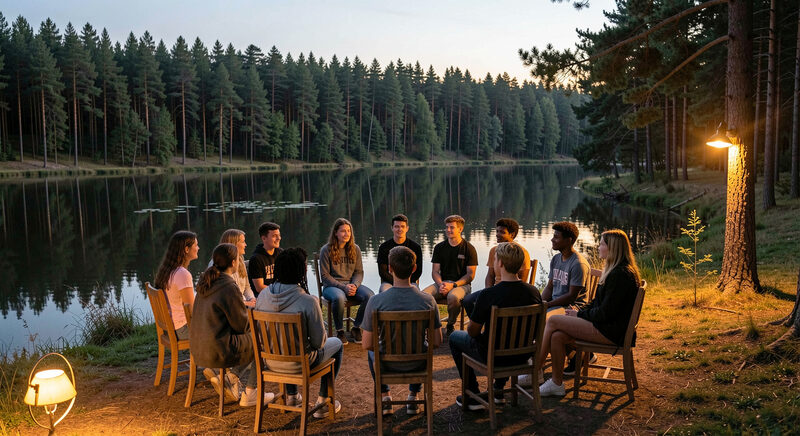
Seeds of Peace is an organisation that brings Israeli and Palestinian teenagers to a summer camp in Otisfield, Maine, for three weeks of living together, facilitated dialogue and the ordinary business of camp life. Founded in 1993, it has produced several thousand alumni and one of the most-studied models in the field of conflict contact work. This profile records how the camp works and what the research says it does and does not change.
How the camp began
The organisation was founded by John Wallach, a journalist who covered the Middle East and argued that the conflict would outlast every negotiation unless the next generation met each other as people first. The first camp session ran in the summer of 1993, timed deliberately with the Oslo breakthrough: the early delegations included teenagers sent with the blessing of governments that were, at that moment, signing the accords. The setting was chosen for its distance. A lakeside camp in rural Maine removes the checkpoints, the flags and the street-level pressure that structure every encounter back home, and replaces them with cabins, a dining hall and a lake.
What three weeks at camp involve
Delegations are selected in the region through schools and partner organisations, and each national group arrives with its own adult coordinators. Days at camp mix the ordinary and the unusual: swimming, climbing and talent shows run alongside daily facilitated dialogue sessions in which small mixed groups work directly on the conflict. The sessions are the documented core of the model. Facilitators trained for the camp guide participants through the events each side names differently, and the disputes inside those rooms, sometimes heated enough to empty them, are part of the design rather than a failure of it. Camp ends with a return home, which the organisation itself describes as the harder half of the program.
What the follow-up looks like
Seeds of Peace runs year-round programming for alumni in Jerusalem and the region, and its alumni network extends into education, journalism, civil society and public life. The organisation reports alumni in visible positions on both sides, including staff in negotiating teams during periods when negotiations existed. The follow-up structure exists because the camp's own literature concedes the central problem: a teenager who has spent three weeks hearing the other narrative returns to a city where that narrative is not welcome, and without a community of fellow alumni the camp experience can fade or curdle.
How a delegation is built
The selection process is part of the documented model. Participants are not self-selected enthusiasts; the organisation has historically recruited through schools and through the Palestinian and Israeli education systems themselves, which means delegations have included teenagers whose families were wary of the program. Each delegation travels with adult advisors who continue the work at home, and the camp's stated aim is not agreement but what the staff call the ability to hold two truths, a participant who can hear the other side's account without surrendering their own.
What the research found
The camp is unusually well documented by outside study. Research following participants before and after camp has consistently found large immediate gains in willingness to engage with the other side and in perceived similarity, and a documented decay of those gains after return, especially where alumni lack ongoing contact. The honest reading of three decades of results is that the camp reliably changes individuals and cannot by itself change the structure they return to, which is roughly what the organisation's own long-serving staff say in interviews.
How the war years tested it
The camp model was built for a conflict at a low boil and has run through intifadas, wars and the collapse of the peace process it was born alongside. The period after October 2023 tested the network hardest: alumni reported grief on both sides, dialogue work was interrupted and rebuilt, and the organisation continued to run sessions with participants whose communities were, at that moment, at war. The documented record is that the camp kept operating, which is itself the finding: the model survives by being deliberately smaller than the conflict.
What alumni say years later
Alumni accounts collected by journalists and researchers converge on a documented pattern: the camp rarely produces activists by itself, but it reliably produces adults who cannot accept the simplest versions of their own side's story, and who describe the dialogue sessions, not the lake, as the experience that stayed. A minority become organisers; the majority describe a quieter effect that surfaces in how they vote, teach or report.
Where it sits among the bridge-builders
Seeds of Peace is the intensive short-form model: three weeks, one generation at a time. The daily-education model is documented in Hand in Hand's Bilingual Schools, the grief-based model in the Parents Circle profile, and the shared-resource model in EcoPeace and the Water Question. The wider frame is in the peacebuilding section.